
Albany City Directory Holdings by Year
The City of Albany directory collection is the main starting point for Albany city directories. It combines holdings from Albany Regional Museum and Albany Public Library. The City reports that all 40 directories in the combined collection were scanned through a 2016 Oregon Heritage All Star Community grant. The PDFs use OCR, so a reader can use Find for a name, street address, business, or phrase, then inspect the page image rather than relying on a search hit alone. The City directory phone is 541-917-7500. Carnegie Library and Albany Regional Museum are the documented in-person alternatives when a screen is not enough.
| Collection | Years | Where Held | Access |
|---|---|---|---|
| Combined Albany digitized directory collection | 40 volumes, beginning 1878 | City of Albany, Carnegie Library, and Albany Regional Museum | City-hosted OCR PDFs or local shelves |
| Early Albany directories | 1878, 1892, 1905, 1909-1913 | City collection and physical copies | PDFs; the 1909-1910 gazetteer also has a documented FamilySearch catalog route |
| Maxon and Salisbury-era volumes | 1936, 1939, 1941-1942, and 1946 | City collection | City PDFs |
| Albany Householders Guide | 1948 | City collection | Address and householder-oriented PDF |
| Later city and rural-route scans | 1950-1989, in documented runs | City collection | Individual City PDFs; later publisher detail is not complete |
The published run is not continuous. The City expressly identifies gaps from 1912 through 1936 and from 1942 through 1946. A missing volume or an empty search inside either interval does not establish that someone was absent from Albany. In addition, the landing page lists individual later PDFs without naming every publisher, so the volume itself is the safer source for publication details. The historic-property bibliography records Mansfield and Monteith for the 1878 directory, Wm. G. Obenaur & Co. for 1892, Polk & Co. for 1905, Albany Directory Company for 1909-1910, and R. L. Polk for 1913.
Note: Treat each Albany city directory as a publication-time record, then verify a material conclusion through its original source or government custodian.
Albany City Directories on the Digital Shelf
Start online at the City collection, select the closest known year, and search both a personal name and a full or partial address. The City describes the scans as showing names, addresses, some telephone numbers, and other city information. That supports a dated household or address lead. It does not make the collection a current resident list. A useful pair of checks is the nearest available volume before a year and the nearest one after it, especially where the record falls near a published collection gap.
The City of Albany's digitized directory collection supplies the OCR instructions and year selection that support this historical Albany city directory search.
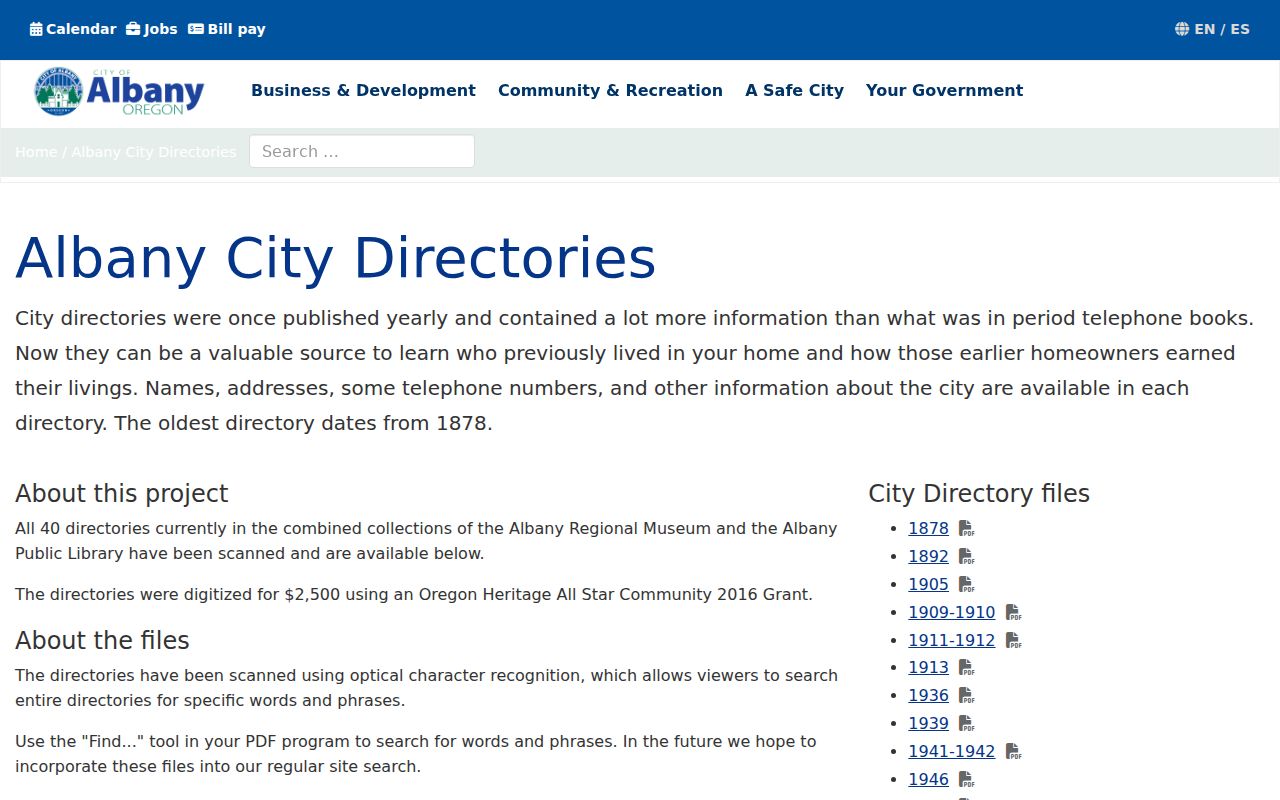
The collection view is a reminder to open the matching PDF page after a text search, because OCR can miss a name, punctuation, or older typeface.
An 1878 volume is available through the collection as an individual PDF, but its entry-level abbreviations were not transcribed during the source review. The safe approach is to inspect the actual page and any introductory material in that particular volume. Avoid turning a general historical convention into a claim about an Albany entry that has not been read. This matters most when an address or household name is the only link between two dated records.
Albany City Directory Research Rooms
Online access is only one channel. The Albany Public Library history portal points to the city-directory scans, historic photos, local newspapers, and related research material. Its Main Library is at 2450 14th Avenue SE, and the Carnegie Library local-history location is at 302 Ferry Street SW. Library staff can help direct a collection search, while publication gaps and copyright or access limits still apply. The City also identifies Albany Regional Museum, 136 Lyon Street S/SW, as an in-person directory route.
Linn Genealogical Society keeps the Tripp Reference Room at Albany Regional Museum, 136 Lyon Street SW. Its documented holdings include city directories, yearbooks, family manuscripts, reference books, e-books, and public-use computers. The Society describes free email lookups in selected Linn marriage and cemetery materials, while other retrieval has its own prepaid terms. An obituary copy is listed at $3 and another record lookup at $1 per page prepaid. Those services can extend a directory lead, but a notice still needs date, place, or official-record support.
The Linn Genealogical Society reference-room route provides the local Albany city directory and yearbook context used for deeper family research.
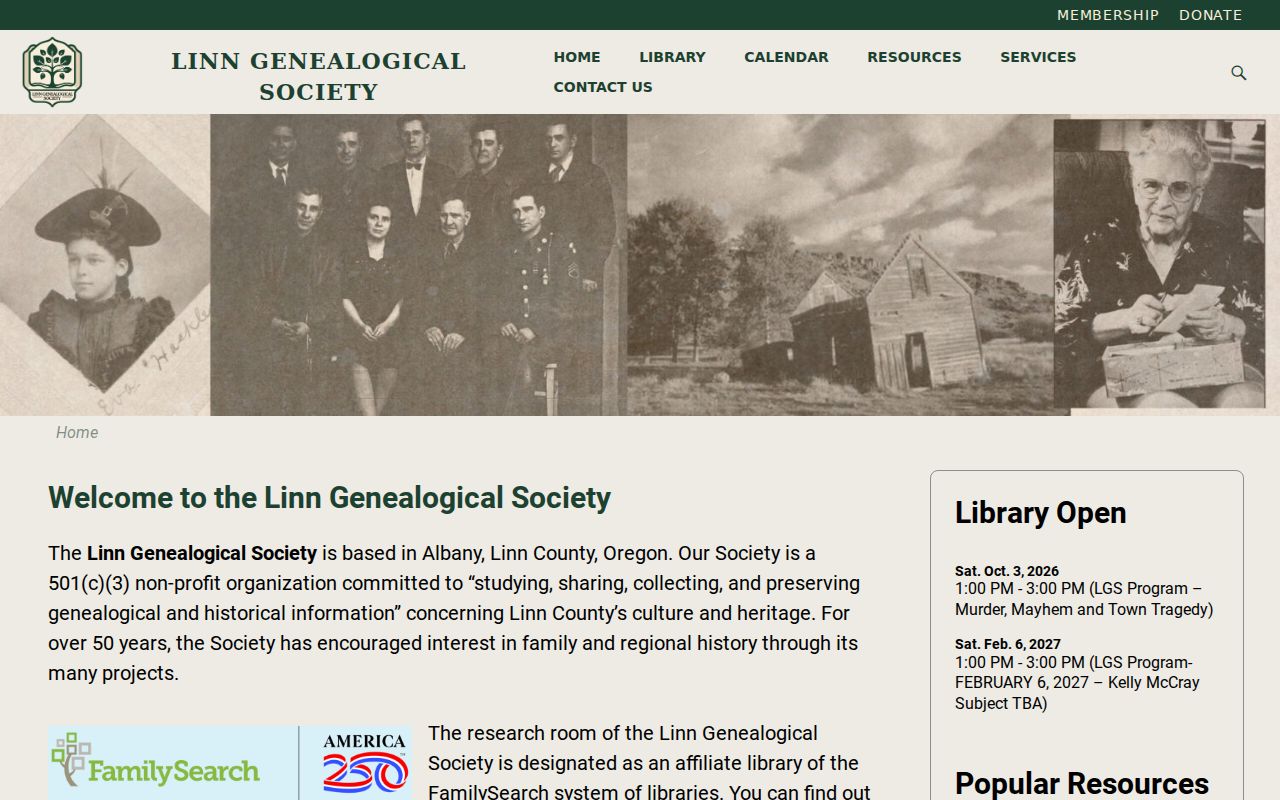
Use the room to identify a book, page, or collection first, then record that citation with the directory year so another researcher can repeat the check.
Reading an Albany City Directory Entry
Albany city directory entries should be read at the level the City actually documents. The collection description supports names, addresses, some telephone numbers, and other city information. It also describes the volumes as evidence of prior household and address connections. The research did not establish a fixed set of family, property-status, or abbreviated entry marks for every volume. Check the entry itself and any key printed in that exact directory before treating a mark as evidence.
| Name | A searchable name lead, best checked against spelling variants and the page image. |
|---|---|
| Address | A publication-time address that can be compared with a map, deed, or another directory year. |
| Telephone information | Some volumes can contain telephone numbers, according to the City collection description. |
| Other city information | The City describes additional local information, but its form and presence must be checked in the selected volume. |
| Unverified entry marks | Do not expand an unverified family, property-status, or shortened mark without reading that volume. |
- Criss-cross directory
- A directory arranged by street or address rather than only by name. Albany's documented 1948 counterpart is address and householder oriented, but the source review did not verify a particular criss-cross label or layout.
- Householder index
- An address-oriented arrangement that helps connect a household entry to a place. The 1948 Albany Householders Guide is the locally documented address-first aid.
- Abbreviation key
- A legend that explains shortened labels in a volume. Inspect the front or back matter of the chosen Albany directory before relying on one.
Note: A directory line is strongest when its year, exact wording, and page image stay with the rest of the research notes.
Albany City Directory Request Fallback
Use the library, museum, and local-history routes first for the historical directory collection. If a separate City-held record is needed, the City public-records request form is the documented general channel. It asks for enough detail to identify the requested record. The City policy normally calls for acknowledgement within five business days and fulfillment or a fee estimate within ten business days after acknowledgement. The form is not a replacement for the digitized directory search or a claim that every historical item is held by the City Recorder.
The City can charge its actual cost. For an estimated cost above $25, its policy requires written notice, confirmation, and prepayment. The research did not locate a current dollar-valued City fee schedule. Police and Fire use separate forms, while medical ambulance records have their own identity-required route. Keep a request focused on the record, year, or collection item needed.
The 1948 Albany Householders Guide
The 1948 Albany Householders, Street & Avenue Guide deserves separate treatment because the City identifies it as address and householder oriented. That makes it useful when the starting point is a known historic address rather than a surname. It is still a single-year publication. Its organization does not prove that every unit, household member, or later address change is represented. Compare its page with a nearby name-oriented directory, a dated map, or a contemporaneous government record before drawing a family conclusion.
Albany's historic setting adds useful companion material. The library's house-history guidance points researchers to city directories, historic inventories, Sanborn maps, newspapers, Albany Regional Museum, and Linn Genealogical Society. The Library of Congress catalogues an 1884 four-sheet Albany, Linn County Sanborn map. It can help interpret building and street context, but it should not be extended to the Benton County portion of today's city or to later street patterns.
Trace Albany Families Through City Directories
For family history, work from a dated entry toward a documented sequence. Search the closest Albany city directory to a known event, save the spelling and address exactly as printed, then compare the next available year. A change can point to a move, a changed listing practice, or an error. It does not settle why a person disappeared. The State Archives inventory lists local census holdings at Albany Regional Museum for 1849, 1860, 1870, 1881, 1905, and 1910, and at Linn County Historical Museum for 1849, 1850, 1860, 1870, 1880, 1900, 1905, and 1910. Those dated holdings can help test a directory lead.
- Choose the nearest available directory year and search the person under spelling variants, then check the page image.
- Record the printed name, address, telephone information if present, volume year, and page number without expanding uncertain abbreviations.
- Compare the nearest available directories on both sides of a gap, keeping 1912-1936 and 1942-1946 as real breaks in the run.
- Pair the dated address with the appropriate census year, property document, or historic map rather than treating a directory as a continuous annual ledger.
- Use an obituary, probate, cemetery, or eligible vital-record channel only as a separate, date-specific check on the trail.
The HeritageHub route gives Albany cardholders 24/7 access to U.S. obituary and death notices with stated coverage from 1704 to the present. University of Oregon Historic Oregon Newspapers offers a different local newspaper channel. A death or funeral notice may not be a full obituary, so it is a lead to corroborate rather than an automatic family conclusion.
Albany City Directory Dates in Context
Albany's record timeline helps explain what a directory can and cannot answer. Linn County was created in 1847, Albany became the county seat in 1851, and the City profile gives an incorporation year of 1864. The directory collection begins in 1878. Earlier property and government records may therefore exist even though a city directory has not yet begun. The Oregon State Archives Linn County inventory is the verified route for series span and repository, not a present-day search result.
| 1847 | Linn County was created. |
|---|---|
| 1851 | Albany became the county seat. |
| 1864 | Albany's official profile gives its incorporation year. |
| 1878 | The earliest Albany city directory in the digitized local collection. |
| 2016 | The City reports that its 40-directory scan project was supported by a $2,500 Oregon Heritage grant. |
Directory access and government custody are separate questions. A city PDF can provide a useful dated clue, while a recorder, court, archive, or county clerk holds its own official series. Albany also spans Linn and Benton counties, so an Albany locality line in a historical volume is not enough by itself to choose a modern parcel or recording custodian.
Albany City Directory Companion Collections
When the directory years do not answer a question, use a collection that matches the date and subject. Albany Public Library and Carnegie Library hold city directories, Sanborn maps, archival material, and links to historic-structure research. The City says Carnegie has Sanborn maps from 1883 through 1955 and historic-newspaper microfilm from 1859 through 1947. Albany Regional Museum can accept historic building and photo research requests. Simple volunteer work may be free for 30 to 60 minutes, while deeper work starts at $25 and scans are listed at $0.25 per page.
The Albany Public Library local-history portal brings together the city-directory, newspaper, photograph, and collection paths described here.
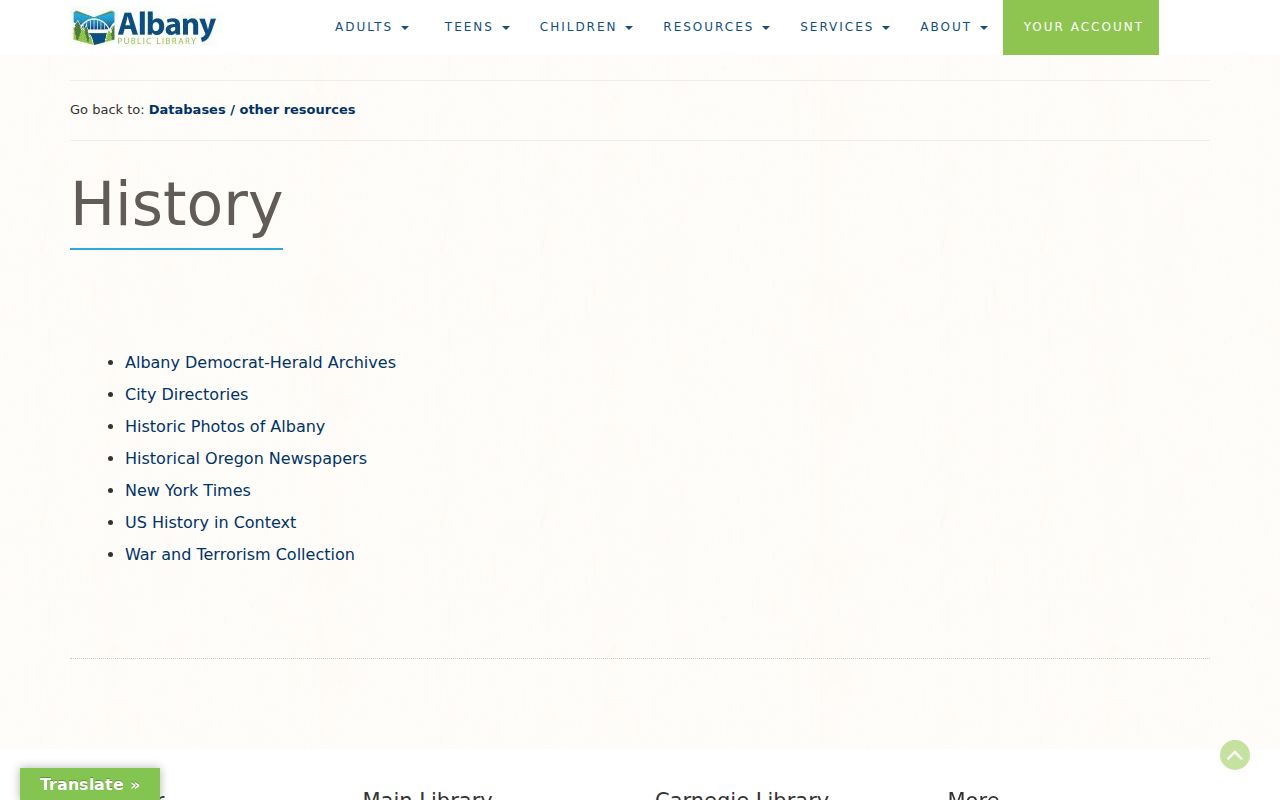
The library collection is most useful when its date and scope are kept distinct from a formal property, probate, or vital-record trail.
Linn County Historical Museum adds cemetery, donation-land-claim, census, marriage, adoption, obituary, photo, pioneer-family, and historic-resource material. LGS also has digitized Linn and Benton death-certificate images through 1965 and more than 900 pages of WPA-era interviews. These collections can deepen the context around a directory entry, but access rules still apply to vital material and a historical source should not be used as proof of a current address.
Note: Keep the collection name, year, page, and county with every Albany city directory result so the next check uses the correct repository.
Limits of an Albany City Directory Search
A directory is a dated publication, not a complete or current roster. A blank result can reflect the two documented gaps, OCR error, a spelling variation, a publication decision, or a changed address. The City itself tells users to search names, street addresses, businesses, and phrases in the PDFs. Repeating that search in the next available volume and checking the page image is more reliable than inferring an absence from one search box.
For a current address-based record trail, the Albany street directory route uses the county parcel, map, and recorder channels rather than historical listings. Historical material is appropriate for family history, a house-history question, or a dated local record trail. Use it lawfully and do not use any record to stalk, harass, or harm another person.